
Ovidiu Goran
by Ana Grozea
Dublin, 24–28 February 2025
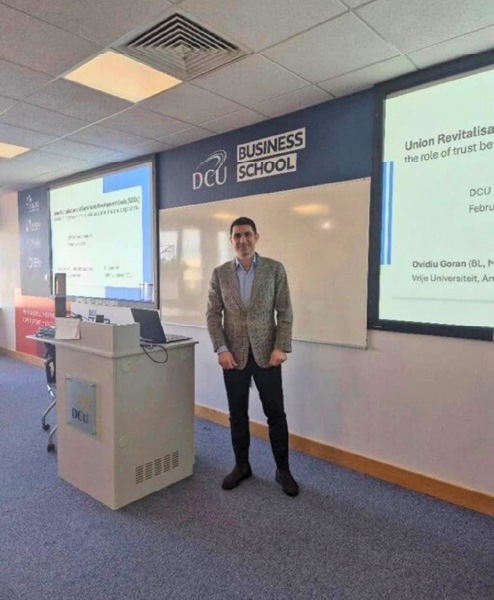
Last week, I had the pleasure of participating in the Research Week organized by DCU Business School.
As a member of OBAIR – DCU’s Institute for Business and Society, I took part on Tuesday in the symposium on “Rethinking the Future of Work.” It was an excellent opportunity to explore the challenges and opportunities of the labor market in the context of climate, technological, and economic change.
On Wednesday, I discovered TrustLAB, an initiative of Dublin City University Business School dedicated to exploring trust in various professional and social contexts.
The ABI model of interpersonal trust (Mayer et al., 1995) highlights three essential components:
Ability – expertise, knowledge, and skills
Benevolence – genuine care and concern for others
Integrity – strong moral and ethical principles
Thursday was dedicated to the Doctoral Colloquium, where I attended remarkable presentations. I also had the honor of presenting one of my upcoming papers:
Union Revitalisation and SDG’s: The role of trust between unions and boards of multinational corporations
The week concluded with an open discussion on the Paris Agreement. This international treaty on climate change, legally binding, was adopted by 196 parties at the UN Climate Change Conference (COP21) in Paris, France, on 12 December 2015, and entered into force on 4 November 2016. A key theme that received significant attention was the impact of the Green Transition on the labor market – a crucial subject requiring ongoing research.
An extremely valuable experience, offering me new perspectives and inspiration for future projects.
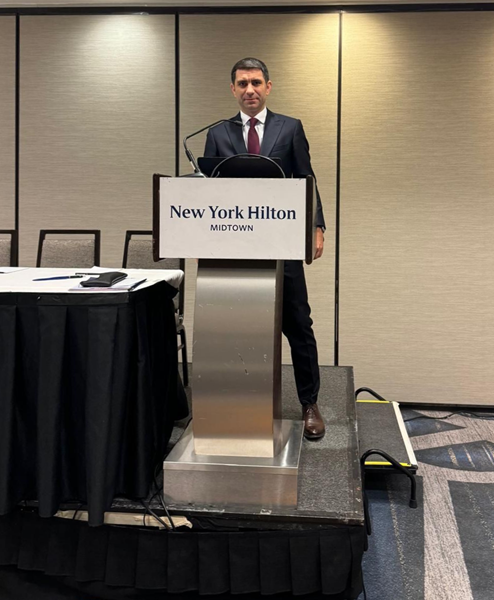
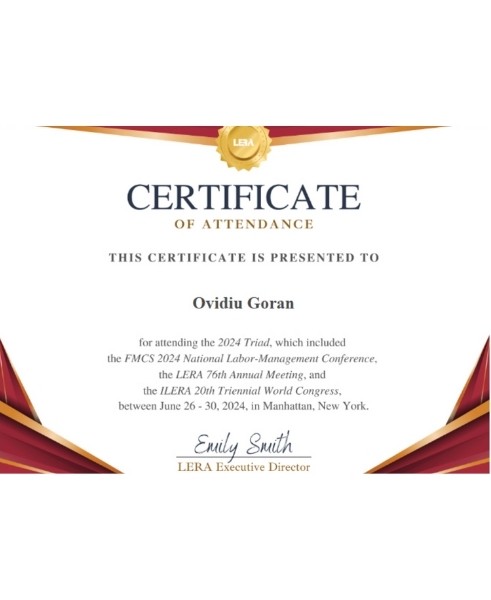
New York, Manhattan | 26–30 June 2024
Mr. Goran had the great pleasure of presenting at the LERA/ILERA/FMCS World Congress on Labor Relations, held in New York on 26–30 June, the paper entitled “Turning Points in Industrial Relations in Romania – Quo Vadis 2022?”, highlighting the key moments in the evolution of industrial relations in Romania.
I would like to extend my warmest thanks to Prof. Dr. Aurora Trif for her constant support and guidance.
Sincere thanks also go to Dr. Martin Behrens and Prof. Dr. Andreas Pekarek for involving me in this project, a collaboration that has proven to be an incredible learning experience.
My final contribution to the congress consisted of presenting a paper entitled “The Decline of Trade Unions – A Systematic Review.”
The paper is a systematic review of the literature on the decline of trade unions across OECD countries, assessing the potential disappearance of unions and contributing to the scholarly debate with a taxonomy of the causes and effects of union decline, a definition and conceptual framework of decline, as well as the introduction of SROI as a novel strategy for union revitalization.
I would like to express my deepest gratitude to Prof. Dr. Svetlana Khapova for her wonderful guidance throughout the systematic review process and for making this amazing journey possible.
This congress will remain an unforgettable experience and an extraordinary learning opportunity.
Vrije Universiteit Amsterdam
Author: Ovidiu Goran
Vrije University, Amsterdam School of Business and Economics
Business Research Institute (ABRI)
Amsterdam, 1081
ABSTRACT
A key challenge in achieving the goal of ‘social justice for everyone, everywhere’ is ensuring the survival of trade unions. While scholars have started to explore how union density, membership, and collective bargaining coverage have declined over the last century, little attention is given to the cause-and-effect relationship leading to unions’ obsolescence, as well as potential evolutionary alternatives for trade unions in the future’s work inequality turmoil. We draw on peer-reviewed research papers in industrial labor relations, economics, sociology, political science, law, business, and management, as well as longitudinal datasets provided by the International Labour Organization, Eurostat, the US Bureau of Labor Statistics, and the OECD.
Following a systematic analysis of the literature on the decline of trade unions, we have identified and coded the main causes and effects, highlighting patterns and tensions to predict potential evolutionary scenarios. Five endogenous and exogenous causes of the decline of trade unions have emerged, coded as technological, regulatory and institutional, organizational, employer-related, and sociological in nature. Consequently, the effects echo in society, the economy, and the trade unions’ power resources. Our findings are then incorporated to formulate a definition and construct a conceptual model illustrating the decline of trade unions.
We support the conclusion that the state, trade unions, and employers need to forge a collaborative partnership to achieve a meaningful social return on investment (SROI). This entails working together strategically and synergistically to maximize the positive impact on society, beyond just financial returns. It involves a shared commitment to social responsibility, employee well-being, and broader societal goals, emphasizing a collective effort toward a more sustainable and socially beneficial outcome.

Aurora Trif
Dublin City University – Business School
Ovidiu Goran
Vrije University, Amsterdam School of Business and Economics
INTRODUCTION
Industrial relations (IR) refer to managing interactions between workers and their representatives (e.g. trade unions– hereafter unions, works’ councils, etc) on the one hand, and employers and their representatives (e.g. employers’ associations or managers) on the other hand, including joint regulations that set the terms and conditions of work (Trif and Paolucci, 2019). Generally, there are two interrelated preconditions for joint regulations by these two parties. The first one is that the legal provisions do not prohibit their freedom of association, collective bargaining rights, and rights to take industrial action. The second precondition is the existence of representatives of workers and employers (IR actors) who can either voluntary or be obliged by statutory provisions to regulate together labour standards. Unlike in Anglo-Saxon countries where IR actors prefer voluntary interactions, there is a strong tradition of relying on statutory provisions to manage the relations between IR actors in Romania (Trif, 2004). Accordingly, the turning points in the Romanian IR have been associated with radical changes in the rights of workers and employers to associate, bargain collectively, and take industrial action. Besides, solely when these changes endured at least 10 years are considered as turning points in IR in this chapter.
Based on these criteria, there have been three turning points in the IR in Romania linked to broader political and economic changes in Europe. The introduction of the communist regime in Romania following the Second World War led to the first major turning point, while the collapse of the communist regime led to the second one. After 1989, Romania developed a distinctive type of neo-liberal society with weak state institutions, high centralization and coverage of collective bargaining (Table 1) and relatively high mobilization power of unions until the 2008 crisis (Bohle and Greskovits, 2012). In exchange for the unions acceptance of economic reforms seeking to transform the centrally planned economy into a market-economy during the 1990s, Romanian governments accepted unions’ demands for a favourable institutional environment (e.g. erga omnes extension of sectoral and cross-sectoral collective agreements) (Table 1). Although Romania had one of the most supportive IR legal context for unions in the region de jure until 2008, de facto it was often difficult to enforce labour regulations (Trif, 2016). Furthermore, the preconditions for international financial assistance imposed by the Troika (i.e. the European Union, the International Monetary Fund and the European Central Bank) have contributed to undermining fundamental union rights (Table 1) during the 2008 international financial crisis, which led to the third turning point. In contrast, the EU instruments adopted after 2017 to support social rights have triggered important legal changes in 2022 strengthening de jure fundamental union rights in Romania (Goran et al., 2023), while it is too early to assess whether these changes will lead to another turning point de facto.
Author: Ovidiu Goran
Vrije University, Amsterdam School of Business and Economics
Business Research Institute (ABRI)
Amsterdam, 1081
ABSTRACT
Over the past century, multinational corporations (MNCs) have shaped the world. The current corporate paradigm prioritises profit over worker well-being, social equity, and environmental sustainability. While scholars have started exploring trade unions’ role in climate change, there is limited research on whether innovative forms of social dialogue within MNCs could contribute to sustainability transitions. This paper examines the potential contribution of multi-stakeholder partnerships between boards of directors and trade unions in MNCs to meet the green transition and sustainability targets. Boards serve as intermediaries between shareholders and management, balancing control and mediation roles. By moving beyond the paradox of control, the boards and trade unions could create innovative corporate structures that challenge the status quo and support a just green transition. Positioned as a manifesto for responsible capitalism and stakeholder democracy, this paper argues that trade unions’ strategies need to extend beyond worker rights to represent and protect humanity.
This paper empirically investigate under which conditions boards and trade unions could cooperate to integrate green and sustainability objectives in the case of a manufacturing MNC with subsidiaries across three countries with different labour institutions (e.g. Germany, Italy and Romania). Based on qualitative data from key stakeholders, it will seek to investigate (i) the potential and current role of trade unions in addressing specific green and sustainable goals by collaborating with the board and (ii) the effects of the level of trust between trade unions and the board on union revitalisation.

Author: Ovidiu Goran
Vrije University, Amsterdam School of Business and Economics
Business Research Institute (ABRI)
Amsterdam, 1081
ABSTRACT
Over the past century, corporations have shaped the world. Boards serve as intermediaries between shareholders and management, balancing control and mediation roles between investors and self-interested management. The current corporate paradigm prioritises economic productivity and neglects the need for a more holistic approach that integrates worker well-being, social equity, and environmental sustainability. Consequently, corporations face diverse expectations from stakeholders and pressure on societal issues.
The proverb, ‘When the fish in a pond is dying, you do not treat the fish; you clean the pond’, serves as a powerful philosophy of life that challenges the very essence of corporate governance. It suggests that scholars and society should concentrate on the root cause rather than the symptoms. This essay’s central argument is that current corporate governance practices are just symptoms of a severely ill economic system that destroyed Mother Earth and is very close to jeopardising all humankind. Changing the system can bring innovation to corporate governance to address the current global crises. Consequently, this essay discusses alternative economic and governance systems such as cooperatives (e.g. Mondragon), steward-ownership (i.e. Patagonia) and the golden share model (e.g. Ecosia).
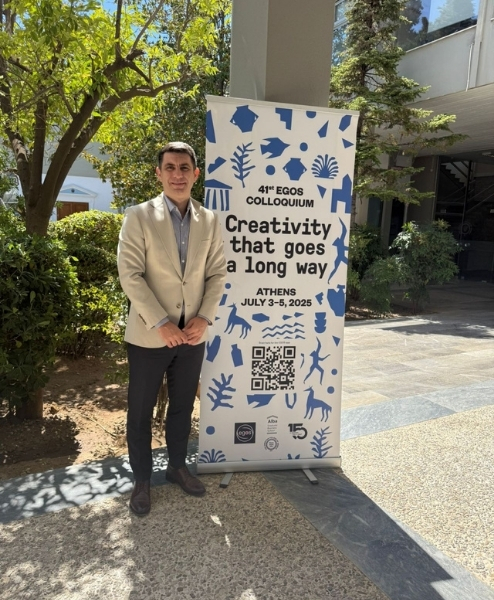
EGOS conference | Athens 3-5 July 2025
“I know that I know nothing.” — Socrates
The more I learn, the more I realise how little I actually know. Every experience shows me just how much there is still to discover and reminds me of the importance of staying curious and courageous.
I had the opportunity to participate in the 41st EGOS (European Group for Organizational Studies) Colloquium, held in Athens from 3–5 July 2025, organised by Alba Graduate Business School and The American College of Greece. This year’s theme — “Creativity that goes a long way” — was a perfect fit for discussions on the future of work and corporate governance.
During the main conference, I presented under Sub-theme 77: Corporate Governance for “Humanity”: Seeking Humble and Contextualised Leadership, with the paper: “Reshaping the world: Building trust between labour and capital in a corporate governance context.” Special thanks to Léo Denis for the valuable feedback as discussant and the thought-provoking questions.
A huge thank you to the sub-theme organisers Prof. dr. Svetlana Khapova, Wafa Khlif, and Joris Berns, for the amazing feedback and for creating such an inspiring and engaging space for dialogue.
It was a truly valuable experience that left me motivated to continue exploring labour relations, trust-building, and sustainable governance.
hashtag#EGOS2025 hashtag#Athens hashtag#Sustainability hashtag#CorporateGovernance hashtag#LabourRelations
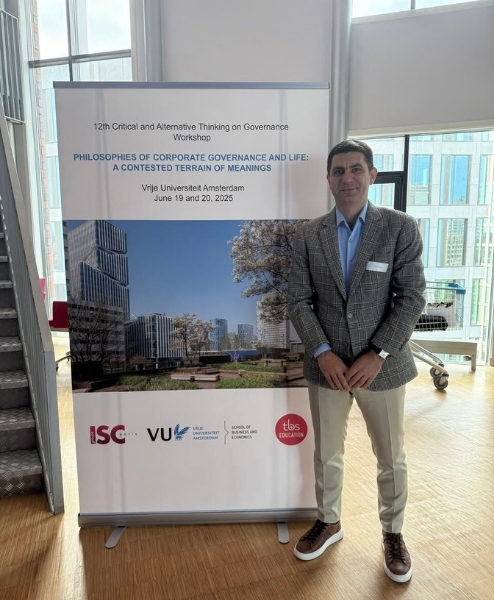
Vrije Universiteit Amsterdam | 19–20 June 2025
I believe that life is, at its core, a collection of memories, shared with family, friends, and through one’s professional journey. Some memories are more powerful than others, and participating in the 12th edition of the “Critical and Alternative Thinking on Governance Workshop” hosted by Management & Organisation, Vrije Universiteit Amsterdam on 19-20 June is undoubtedly one of those meaningful experiences.
This year’s theme, ‘Philosophies of Corporate Governance and of Life: A Contested Terrain of Meanings’, created a generous space for reflection on the meaning, practice, and future of governance in a constantly evolving world.
It was a real pleasure to present the paper: ‘Corporate Innovation and Alternative Economic Systems: Cleaning the Pond of Corporate Governance’ In this work, I propose a reconfiguration of governance so it can better respond to the needs of emerging, sustainable economic paradigms. The paper is grounded in the belief that we cannot truly reform governance without addressing the economic system it supports. At its core lies the metaphor:
“When the water is toxic, you don’t treat the fish; you clean the water”, a philosophical invitation to discuss root causes rather than symptoms.
This paper joined the conversations on how multinational corporate structures prioritise economic productivity, often at the expense of social equity, employee well-being, and environmental sustainability. Boards of directors are frequently caught between shareholder pressures and societal expectations, highlighting the limitations of a profit-maximisation model.
To show that alternatives not only exist but are viable, I included three case studies in the paper:
The proposed transformation is not cosmetic—it’s ontological. These firms don’t just do business differently – they redefine what “a business” is for.
I was honored to participate as a discussant, offering my perspective on Professor Steven ten Have’s insightful paper on purposive corporate governance models. His contribution combines solid methodology with deep impact.
And because professional memories are all the more special when paired with personal ones, visiting the Rijksmuseum, where I was fortunate to admire the works of Rembrandt, was a moment of quiet inspiration that rounded off the entire experience.
Many thanks to Prof. dr. Svetlana Khapova, Prof. Wafa Khlif, Prof. Lotfi Karoui, PhD, MBA, BBA, dr. Agota Szabo, Andra Iacob and the organising team at Management & Organisation, Vrije Universiteit Amsterdam, TBS Education – Barcelona, and ISC Groupe Paris for creating such a meaningful space for critical reflection and alternative thinking.